
Car Shaking When Braking? Where You Feel It, the Causes and What to Do

A car that shakes only when you brake is telling you something specific. The shake comes from the brakes, or from parts that only take the load when the car slows down. The most common brake cause is a rotor that is no longer the same thickness all the way around, but it is not the only one. Where you feel the shake is the first clue. A car that shakes all the time is a different problem, covered further down.
Where you feel it
- In the steering wheel. A shimmy you feel in your hands usually points to the front: front rotors, front calipers or worn front suspension parts.
- In the brake pedal. A pedal that pulses up and down under your foot means the pads are meeting an uneven surface. That can come from the front or the rear rotors.
- In the seat or the whole car. A shudder through the body while the steering wheel stays steady often points to the rear brakes.
These are only tendencies, so a technician still checks both ends of the car.
The usual causes
Uneven rotors or pad material on the rotor
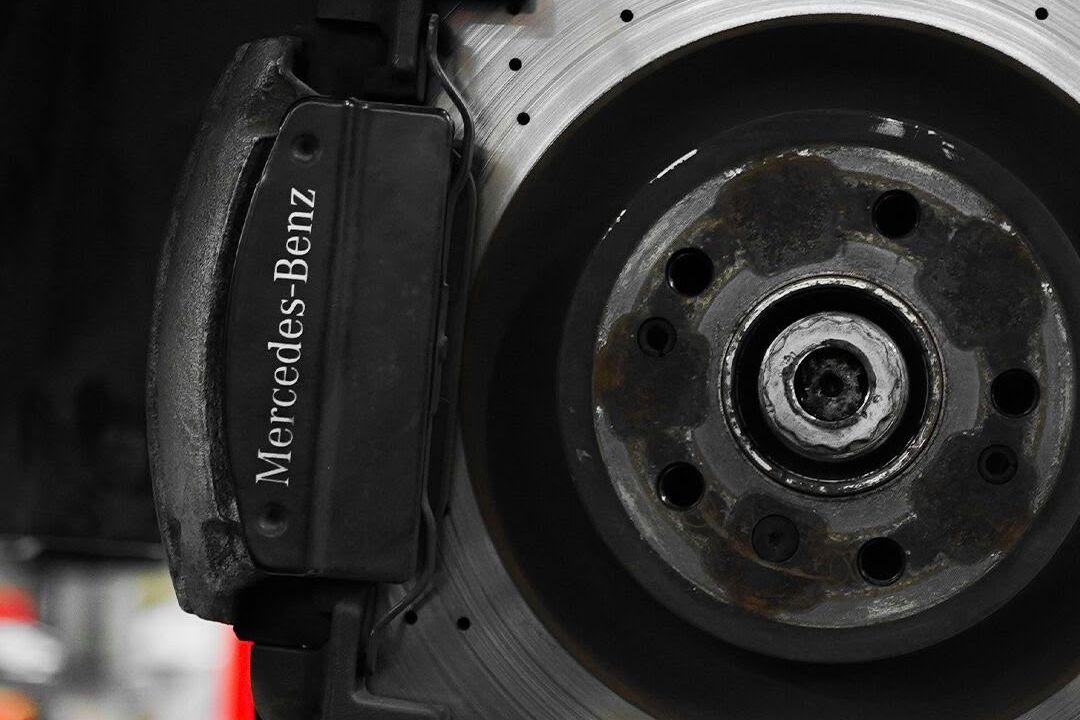
People call it a warped rotor. Most of the time the rotor is not bent. Its thickness has become uneven, or pad material has built up in patches on its face. Either way, the pads grab and release as the rotor turns, and you feel that as a pulse. It often starts with a rotor that runs slightly out of true on the hub, from rust or dirt between the two or from wheel bolts tightened unevenly. Holding the brake pedal down hard at a stop right after heavy braking can also leave a print of pad material on a hot rotor.
In the trade, uneven rotors are sometimes resurfaced on a lathe. Many modern rotors do not have much thickness to spare, and the minimum thickness stamped on them often makes new rotors and pads the answer.
A sticking caliper or slide pin
A caliper has to let go when you lift off the pedal. If its piston or slide pins stick, the pad keeps rubbing on that wheel. The rotor runs hot, wears unevenly and starts to pulse, and the car may pull to one side, sometimes even when you are not braking. That wheel may also be dirtier with brake dust than the others.
Worn suspension bushings or ball joints
When you brake, the weight of the car pushes forward and the front wheels get pushed back. Good bushings and ball joints hold them in place. Worn ones let the wheel shift, and you get a shimmy that only shows up under braking, often at highway speed. On many BMW and Mercedes-Benz models, worn front control arm bushings are a common cause of exactly this. New rotors will not fix it.
A worn wheel bearing
A bearing with play lets the hub, and the rotor bolted to it, wobble slightly. The pads feel that wobble as a pulse. A worn bearing usually also hums or growls, and the noise changes with speed or when you turn.
ABS on a slick road
If you brake hard on a wet road, in a summer downpour for example, and feel rapid pulsing in the pedal with a buzzing or grinding sound, that is usually the ABS keeping the wheels from locking. It is normal. Keep firm pressure on the pedal and steer. If the pedal pulses like that during gentle stops on dry pavement, have it checked, because a faulty wheel speed sensor can set off the ABS when it should not.
If it shakes without braking
If the car shakes at certain speeds whether you are braking or not, the brakes are probably not the cause. The usual suspects are the wheels and tires: a wheel out of balance, a rim bent by a pothole, or a tire with a damaged belt. That is work for a tire shop, not a brake repair. If the shake started after a hard pothole hit, have an alignment shop check the alignment as well.
When to stop and call a tow
If the car pulls hard to one side when you brake, if the pedal pulses along with a burning smell, or if one wheel is much hotter than the others, stop where it is safe and have the car towed.
These are signs of a caliper that is not letting go or a brake that is overheating, and both can get worse quickly. A burning smell or smoke from one corner is enough to go on.
Never touch a wheel or rotor after driving to check how hot it is. They get hot enough to burn your skin.
How it is diagnosed
A road test comes first, to feel when and where the shake happens. Then the wheels come off. A technician measures rotor thickness at several points around the rotor and checks runout, looks at the pads for uneven wear and hot spots, and checks that each caliper releases. The suspension gets checked for play at the bushings, ball joints and wheel bearings, because new rotors on a car with a worn bushing will start shaking again.
Related services at DS Proformance
At DS Proformance in Kendall we measure rotor thickness and runout and check for uneven wear that points to a sticking caliper, so the repair matches the cause. Our brake services page covers the brake side, our suspension and steering page covers bushings, ball joints and wheel bearings, and if the car is not safe to drive, contact us and we will help you plan how to bring it in.


 Chat with Us